

Guide
The cold email playbook
The thinking behind a campaign that actually books meetings. Execution is the thin end of the wedge, the foundation under it is what makes it work.
Preparation
Before any sending, build the foundation:
- Write case studies segmented by ICP: size, industry, pain points, and the infrastructure that matters to your service.
- Capture the email and social messages that show up during real sales conversations.
- Gather first-party data on current and past clients. Interview them. Build a demographic picture of who actually buys.
Use that first-party data to surface the real pain points and the exact language people use, then match them as tightly as you can to your results and assets. This is also how you stand apart from competitors, beyond copy.
Put the research to work
- Pain points across segments. A CMO at a 50-person tech company and a 500-person one feel different pains. Treat them differently.
- Segment deeper than title. Look at the contexts that create different pains, for example teams using one tool versus another, or teams with a sales function versus none.
- Hunt for triggers. If clients tend to seek you out around a certain event, like scaling a department, find companies showing that signal.
- Sharpen the offer. Ask why someone would give you 30 minutes. Without strong proof, a generic ask gets little traction.
- Use lead magnets. Something free that speaks to the pain builds trust. It has to be genuinely useful, a loosely related e-book will not cut it.
- Check your volume. Cold email may not fit a small total market (say under 10-15k decision-makers). Do not burn the whole market in 2-3 months. If it is tiny, build message-market fit elsewhere first, like cold calls.
Using AI to build campaigns at scale
To create resonance at scale you need to do a lot, fast: format and validate contact data, then enrich for personalization factors like triggers and context. Tools like Clay keep this work in one place. As an example, layered enrichment runs can separate senior from junior titles, map the hierarchy, and cross-reference location so the right decision-maker surfaces. AI is now a minimum requirement for building hyper-relevant campaigns that earn replies.
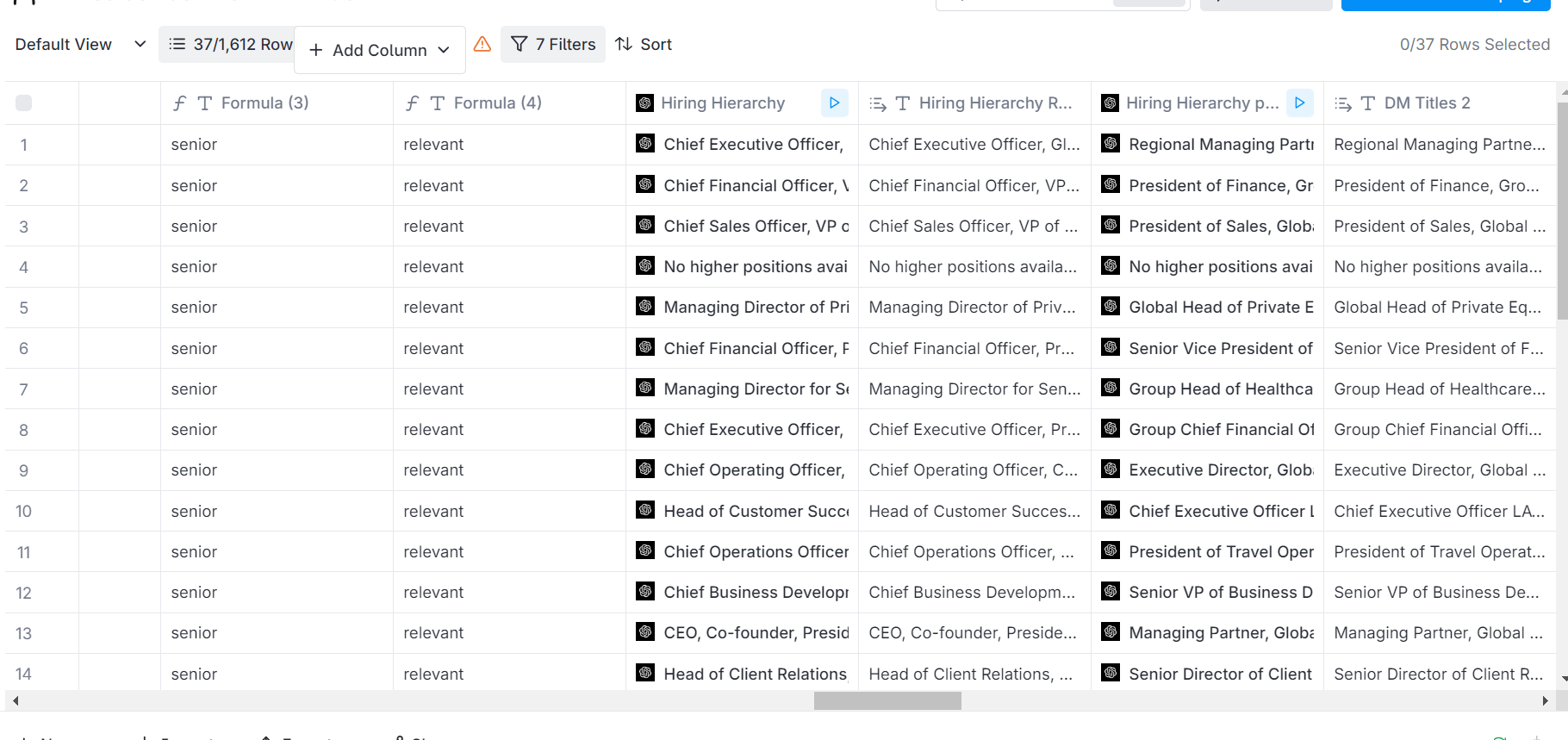
A real enrichment table: AI formulas separate senior titles, map the hierarchy, and locate the right decision-maker.
Running the campaign
- Email is not set-and-forget. Enrichment and inbox management take most of the time.
- Be ready to respond fast, through automated subsequences or reply alerts.
- Plan for the many leads that reply but do not book, they need a path too.
- Start with the ideal enrichment strategy, but accept that not everything can be enriched for.
Copywriting tips
- Lead with your strongest leverage. Strong proof? Use it. Weak proof? Lean on a better offer or lead magnet.
- Match proof and offer to the segment as tightly as you can.
- Shorter is usually better, but not so short that context is lost.
- Sloppy formatting kills credibility. A stray space can scream "automated." Check it.
A reliable structure for a cold email:
- Personalization that grabs attention and ties to a pain you can solve.
- Social proof that is strong and matched to the reader.
- CTA, either a soft question or a relevant lead magnet.
Benchmarks
Skip open rates. Reply rate is a better read on targeting, though it varies by market, in a saturated space a 4% reply rate that books consistent meetings can be a win. Focus on positive replies. Lots of angry or confused "this is not for me" replies usually mean targeting is off, so pause and fix it.
Real numbers from three campaigns (anonymized):
| Sent | Replied | Positive replies |
|---|---|---|
| 741 | 16 (4.20%) | 2 (12.50%) |
| 1,385 | 40 (5.59%) | 12 (30.00%) |
| 759 | 15 (3.86%) | 5 (33.33%) |
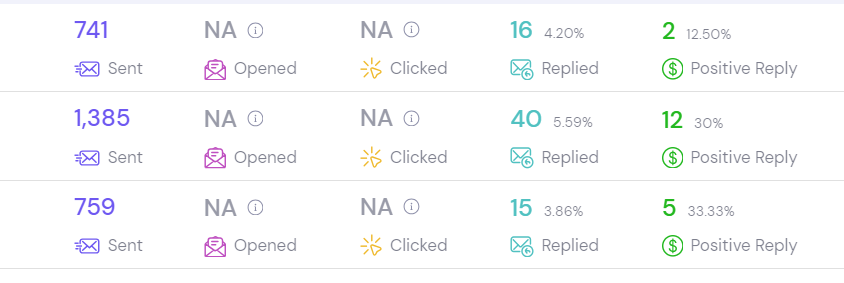
The same three campaigns, straight from the sending tool.
17 opportunities from these campaigns. Not heavily personalized, but tightly segmented so the offer matched the audience.
Want us to run this for you? →